
You trained your model.
Validation metrics look solid.
Cross-validation checks out.
You deploy it.
Two weeks later—performance drops.
No code changes. No pipeline failures.
Just… silent degradation.
🚨 The Reality Most Beginners Miss
In controlled environments, we assume:
Train data ≈ Future data
In production, this assumption breaks almost immediately.
Why?
Because data is not static. It evolves with:
• User behavior changes
• Market dynamics
• Seasonality
• External shocks (pricing, policies, competition)
And when data changes, model assumptions break.
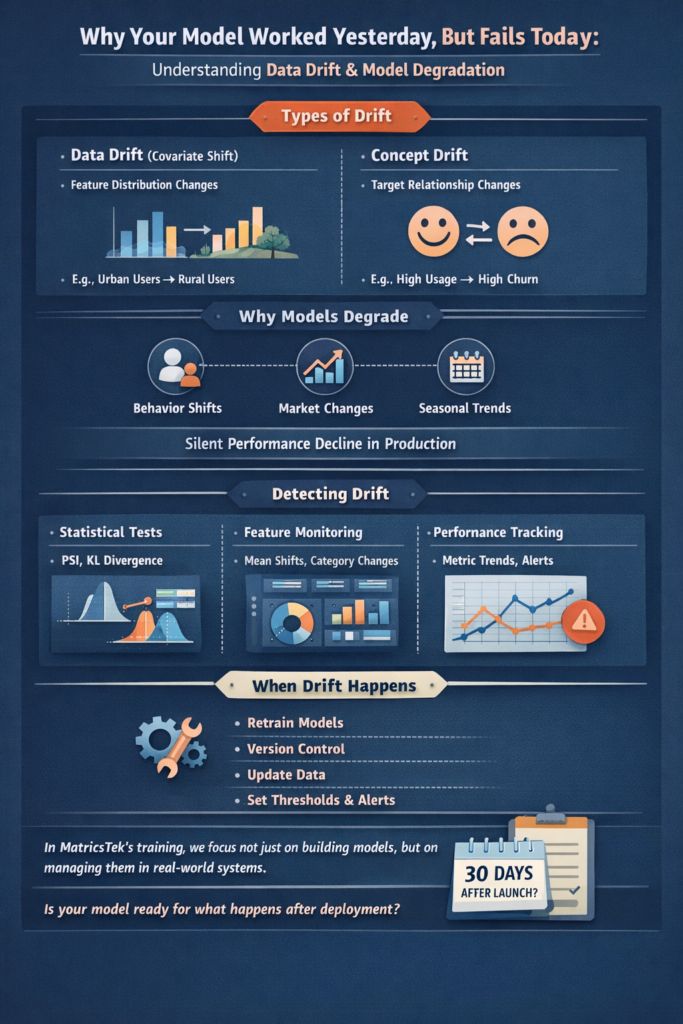
🔍 Two Types of Drift You Must Understand
- Data Drift (Covariate Shift)
The distribution of input features changes over time.
Example:
• Earlier: Majority users were from urban regions
• Now: Increased rural adoption
Your model was never trained for this shift.
- Concept Drift
The relationship between features and target changes.
Example:
• Earlier: High usage → low churn
• Now: High usage → burnout → higher churn
Same feature. Opposite meaning.
This is far more dangerous—and harder to detect.
Why Your Model Fails Silently
Most ML systems don’t fail loudly.
They degrade gradually:
• Precision drops
• Recall weakens
• Business KPIs decline
But unless you’re monitoring properly, you won’t notice until it’s too late.
How Do You Detect Drift?
This is where strong candidates stand apart.
- Statistical Monitoring
Compare training vs production distributions:
• Population Stability Index (PSI)
• Kullback-Leibler (KL) Divergence
• Jensen-Shannon Divergence
These help quantify how much your data has shifted.
- Feature-Level Monitoring
Track:
• Mean / variance shifts
• Category distribution changes
• Missing value spikes
Even a small upstream pipeline issue can trigger drift-like symptoms.
- Model Performance Monitoring
• Track metrics over time (not just once)
• Segment-wise performance (region, cohort, time)
• Alerting thresholds for degradation
What Do You Do When Drift Happens?
Detection is only half the job.
✅ 1. Retraining Strategy
• Periodic retraining (weekly/monthly)
• Trigger-based retraining (when drift threshold breached)
✅ 2. Data Versioning
• Track which data version trained which model
• Ensure reproducibility
✅ 3. Model Versioning & Rollbacks
• Maintain previous stable versions
• Roll back if performance drops
✅ 4. Online vs Offline Learning
• Batch retraining vs real-time adaptation
• Depends on use case sensitivity
✅ 5. Feedback Loops
• Capture actual outcomes
• Continuously update training data
What Interviewers Are Actually Testing
When this scenario comes up, they’re not checking if you’ve used a fancy library.
They’re evaluating:
• Do you understand ML in production, not just notebooks?
• Can you think in terms of systems, not models?
• Are you aware of failure modes in real-world deployments?
What Strong Candidates Say
Instead of:
❌ “I’ll retrain the model if accuracy drops”
They say:
✅ “I would implement drift detection using PSI/KL divergence, monitor feature distributions and model performance over time, and set up trigger-based retraining pipelines with version control.”
That’s a completely different level of thinking.
🏗️ A Subtle but Important Gap
Many learning paths focus heavily on:
• Algorithms
• Model building
• Optimization
But very little on:
• Monitoring
• Maintenance
• Lifecycle management
This gap becomes painfully visible in interviews.
In our mentoring conversations at MatricsTek, this is something we consciously emphasize—helping learners move from model builders to ML practitioners who understand production realities.
Final Thought
A model that performs well once is not impressive.
A model that performs consistently in a changing environment is.
If you’re preparing for interviews or working on projects, ask yourself:
👉 “What happens to my model 30 days after deployment?”
If you don’t have an answer yet—
that’s exactly where your next level of learning begins.