
In today’s digital-first world, downtime is not just an inconvenience—it’s a direct business risk.
From financial services to healthcare to e-commerce, organizations are expected to operate with near-zero downtime, even in the face of unexpected disruptions. This is where cloud computing has fundamentally transformed disaster recovery strategies.
But here’s the shift most professionals miss:
Disaster Recovery is no longer just an IT responsibility.
It is now a core skillset for modern tech professionals, especially those targeting cloud computing jobs in the USA.
At MatricsTek Inc., we see a growing gap between what candidates learn and what the industry actually expects. This blog bridges that gap—technically, practically, and strategically.
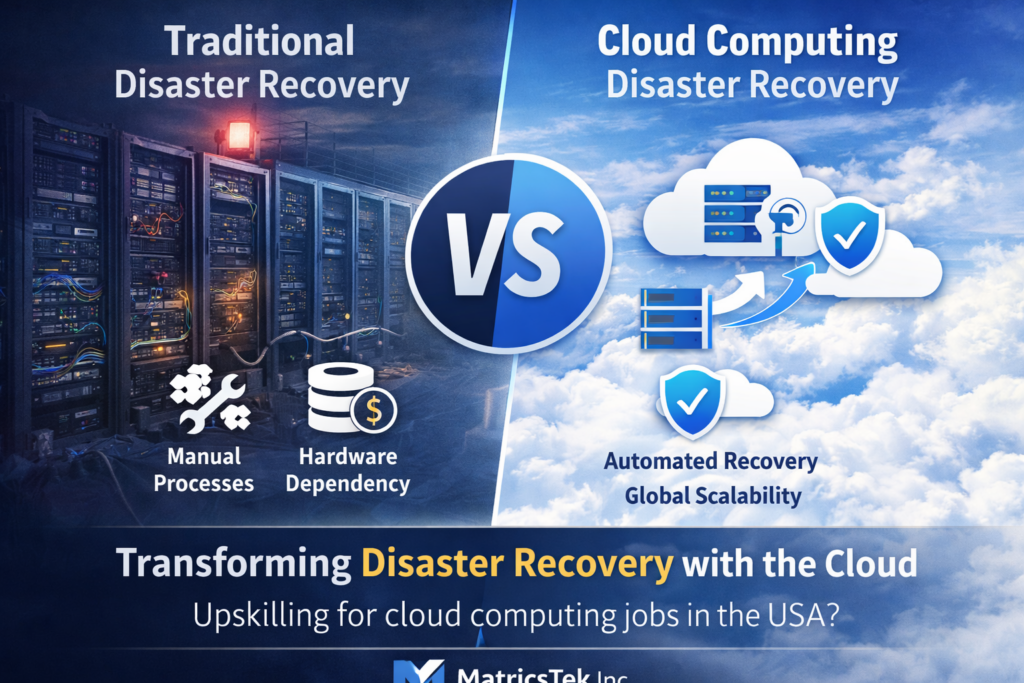
Traditional Disaster Recovery: The Legacy Approach
Before the rise of cloud computing, disaster recovery relied heavily on on-premises infrastructure.
Typical characteristics included:
• Manual backup processes
• Physical data centers with limited redundancy
• High capital expenditure (CapEx)
• Long recovery times (RTO) and potential data loss (RPO)
• Dependency on internal IT teams for every recovery step
While these systems worked in the past, they struggle to meet today’s expectations of speed, scalability, and resilience.
Cloud Computing: A Paradigm Shift in Disaster Recovery
Cloud computing has redefined disaster recovery from a reactive process to a proactive, automated, and resilient system design.
Let’s break down how:
- Automation & Reliability: From Manual Recovery to Self-Healing Systems
In traditional environments, disaster recovery often involves manual intervention, increasing the risk of human error.
With cloud computing platforms like AWS (Amazon Web Services):
• Automated backups and snapshots are standard
• Failover mechanisms trigger automatically
• Infrastructure can be recreated using Infrastructure as Code (IaC)
Result: Faster recovery, reduced errors, and higher reliability - Global Infrastructure: Designing for Geographic Resilience
Cloud providers offer multi-region and multi-availability zone deployments.
This means:
• Data can be replicated across continents
• Applications can failover to alternate regions instantly
• A localized disaster does not disrupt global operations
In cloud computing jobs in the USA, understanding multi-region architecture is a highly valued skill. - Broad Network Access: Recovery Without Boundaries
Traditional disaster recovery is often tied to a specific physical location.
Cloud computing eliminates this constraint:
• Systems can be accessed securely over the internet
• Teams can initiate recovery from anywhere
• Remote operations become seamless
This is especially critical in a world of distributed teams and remote work environments. - Rapid Elasticity: Scaling During Crisis
One of the most powerful features of cloud computing is rapid elasticity.
During a disaster:
• Resources can be provisioned instantly
• Systems can scale up to handle recovery workloads
• No need for hardware procurement or setup delays
This ensures minimal downtime and faster business continuity. - Reduced Operational Burden: Focus on Strategy, Not Hardware
In traditional setups:
• IT teams manage hardware, backups, and recovery processes
In cloud environments:
• Providers manage infrastructure
• Organizations follow a shared responsibility model
• Teams focus on architecture, security, and optimization
This shift is crucial for professionals transitioning through data science training or moving into cloud roles.
Why This Matters for Job Seekers in the USA
The demand for cloud-skilled professionals is rapidly growing, especially in roles such as:
• Cloud Engineer
• Data Engineer
• DevOps Engineer
• Site Reliability Engineer (SRE)
• Data Scientist with cloud exposure
However, here’s the reality:
Many candidates are still preparing with a traditional mindset, focusing only on:
• Basic backups
• Static infrastructure
• Isolated system design
The New Expectation
Employers hiring for cloud computing jobs in the USA are looking for professionals who can:
- Design high availability systems
- Implement disaster recovery strategies on AWS
- Understand RTO (Recovery Time Objective) & RPO (Recovery Point Objective)
- Build resilient, scalable architectures
- Integrate data pipelines with cloud infrastructure
The Intersection of Cloud Computing and Data Science
A critical but often overlooked aspect:
Modern data science training is incomplete without cloud exposure.
Why?
• Large-scale data processing happens on cloud platforms
• Machine learning pipelines rely on scalable infrastructure
• Real-time analytics requires high availability systems
Cloud-native tools like:
• AWS S3 (storage)
• AWS EC2 (compute)
• AWS Lambda (serverless)
• AWS RDS & Redshift (databases)
…are becoming foundational for data professionals.
From Learning Tools to Thinking in Systems
At MatricsTek Inc., we emphasize a crucial shift:
Learning tools in isolation
Thinking in systems, scalability, and resilience
Because in real-world scenarios:
• Failures are expected
• Downtime is unacceptable
• Systems must recover automatically and intelligently
How to Prepare for Cloud Computing Jobs in the USA
If you are serious about building a career in cloud:
Focus Areas:
• Cloud platforms (AWS, Azure, GCP)
• Disaster recovery architectures
• High availability system design
• Infrastructure as Code (Terraform, CloudFormation)
• Integration with data science workflows
Practical Approach:
• Work on real-world cloud projects
• Simulate failure scenarios and recovery
• Build end-to-end pipelines
• Learn to optimize for cost, performance, and reliability
Final Thoughts
Cloud computing has transformed disaster recovery from a technical afterthought into a strategic necessity.
And for job seekers:
It has become a non-negotiable skill.
The question is no longer:
“How do you recover from failure?”
But:
“How do you design systems that are failure-ready?”
At MatricsTek Inc., we help aspiring professionals move beyond theory and align with real-world industry expectations—bridging the gap between learning and employability.
Are you preparing for yesterday’s infrastructure or tomorrow’s cloud-first world?
#cloud computing #disaster #recovery #cloud #computing #jobs #in #USA #AWS #data #science #training #cloud #architecture #high #availability #systems #DevOps #SRE #digital #transformation