
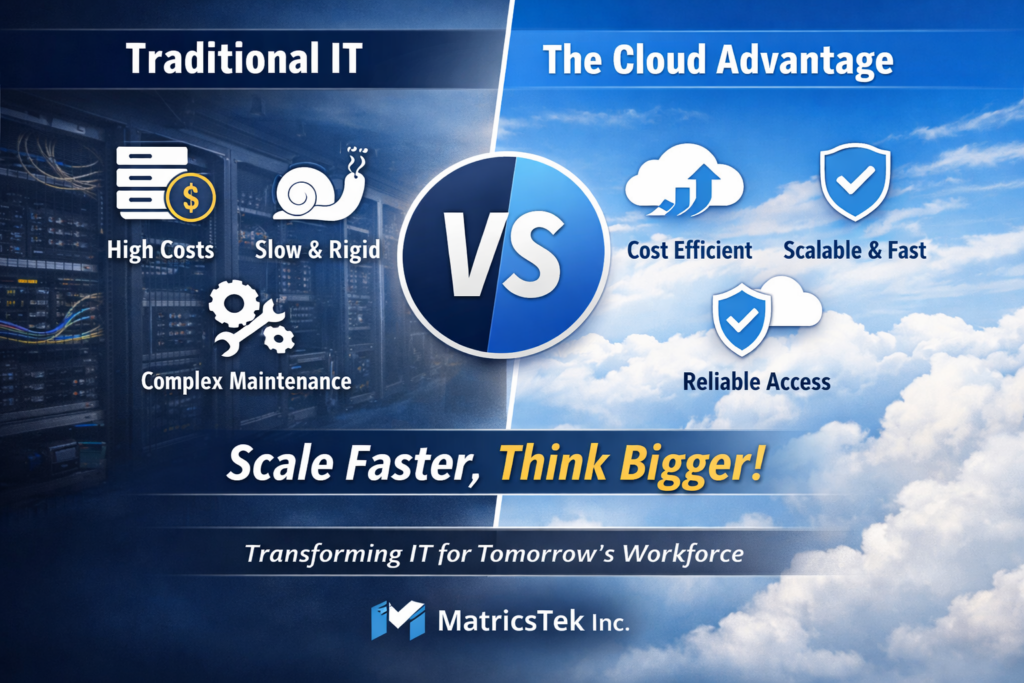
In the rapidly evolving world of technology, the foundation of how businesses operate is shifting from physical server rooms to the elastic, scalable world of the Cloud. For professionals pursuing data science training, understanding this underlying infrastructure is critical, as most modern analytical tools and large-scale datasets now reside in cloud environments. Moreover, as the demand for digital transformation grows, expertise in cloud migration and management has become a top requirement for high-paying jobs in USA and globally.
This blog explores the fundamental differences between the traditional IT approach and modern cloud infrastructure.
Understanding the Traditional IT Approach : The traditional IT approach is built on the concept of physical ownership and local management. In this model, a company must build or rent a physical space, such as a dedicated data center or a server room, to house its operations.
Key characteristics of this model include:
- Physical Procurement: Organizations must purchase hardware like servers, storage devices, and networking gear.
- Software Installation: The company is responsible for installing applications, databases, and operating systems manually.
- Total Ownership: All data and systems are physically located on-site or in a privately leased facility.
- High Upfront Investment: This model requires large upfront investments (CapEx) for equipment, alongside continuous costs for power, cooling, security, and specialized IT staff.
The Challenges of “On-Premise” Systems
While traditional IT offers total control, it comes with significant bottlenecks that can hinder a modern business’s growth. The problems with the traditional approach include:
- Manual Scaling & Underutilization: Scaling resources up or down is a slow, manual process, often leading to resource underutilization where expensive hardware sits idle.
- Operational Burden: It is IT staff intensive, as the internal team is solely responsible for setting up, securing, maintaining, and upgrading everything.
- Disaster Recovery: Managing data backup and recovery is often complex and manually driven.
- Limited Access: On-premise infrastructure usually provides limited remote access, which is a significant drawback in today’s mobile-first world.
The Cloud Revolution: Key Features and Benefits
Cloud computing introduces a paradigm shift by offering on-demand self-service and broad network access. Instead of managing physical hardware, businesses leverage a provider’s massive global infrastructure.
Key Features of Cloud Computing:
- Rapid Elasticity: You can scale resources instantly based on demand, allowing you to stop guessing capacity.
- Measured Service: The “pay-as-you-go” model ensures that you only pay for what you use, leading to greater cost efficiency.
- Automated Updates: Security patches and software updates are often handled by the cloud provider.
- High Availability: Cloud providers offer built-in redundancy, ensuring systems remain reliable and accessible over the internet.
Comparing the Two: At a Glance
| Feature | Traditional Approach | Cloud Approach |
|---|---|---|
| Infrastructure Ownership | Owned and maintained by the organization | Owned and managed by cloud providers |
| Upfront Cost | High (CapEx) | Low (OpEx) |
| Scalability | Limited and slow | Rapid and flexible |
| Maintenance | Manual (Internal IT staff) | Handled by provider |
| Deployment Speed | Slow | Fast |
| Access | On-premises only | Accessible over the internet |
| Security | Organization’s responsibility | Shared responsibility model |
| Backup & Recovery | Manual and complex | Automated and streamlined |
Strategic Business Impact
The decision to migrate to the cloud is driven by the ability to increase speed and agility. By trading capital expenses for operational expenses, companies can benefit from massive economies of scale and reallocate their budget from maintaining data centers to driving innovation.
Furthermore, the cloud allows businesses to “go global in minutes” by leveraging a provider’s globally available infrastructure. For those looking to secure the best jobs in USA, mastering these cloud concepts is no longer optional—it is the baseline for the modern tech workforce. Whether you are undergoing data science training or specialized IT certifications, the cloud is where the future of technology is being built.